
Short answer: You do not need to speak Vietnamese to get a good haircut in Hanoi, but about ten written phrases remove most of the risk. The ones that matter are a length in centimetres, the words for thinning, fringe, darker, lighter and stop, plus one question about bleach. Save them on your phone, show the screen, and say the number out loud before anything is cut.
Why ten written phrases beat one long conversation
A number travels, an adjective does not
Short, trim and not too much all survive translation and still mean nothing. Two centimetres means two centimetres in every language. Every instruction you turn into a number cannot be misread. Everything you leave as an adjective is a guess somebody else has to make for you.
Showing a sentence beats saying it
Vietnamese is tonal, so the same syllable on a different pitch is a different word. A stylist reading your screen understands you perfectly, while the same stylist hearing an untoned attempt may hear something else. This is not about your accent. It is about which channel carries your meaning intact, and the written channel wins.
Where a translation app quietly lets you down
General apps handle hello and thank you, then fall over on salon vocabulary: layers become geological strata, thin out becomes slim down, roots become plant roots. The phrases below are what our stylists hear from Vietnamese clients every day, so they land first time. Our guide to the English supported salon visit in Hanoi explains what the salon does from its side.
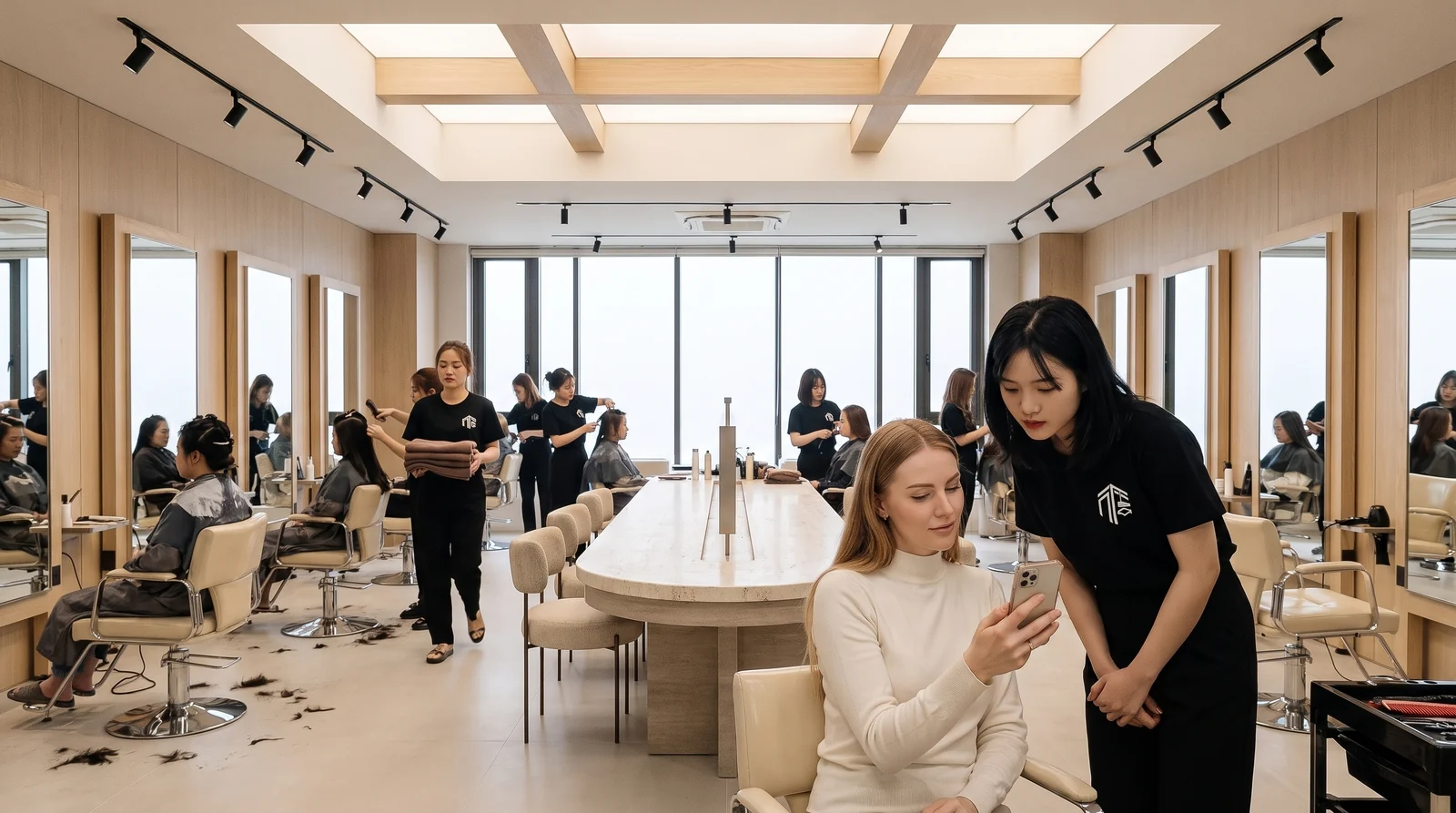
First, how you will be addressed
Why you will be called chi
Vietnamese pronouns carry age and relationship. Speaking to an adult woman client, a stylist will usually say chị, roughly older sister, and it is simply polite. You are not being aged. In your own sentences tôi for I is always correct.
The syllable that makes everything polite
Ending a sentence with ạ is the cheapest politeness in the language. Dừng lại is stop. Dừng lại ạ is please stop. Keep it on every phrase and you will never sound abrupt.
The ten phrases that prevent most misunderstandings
| What you mean | What to show | When to use it |
|---|---|---|
| Cut two centimetres only | Cắt ngắn 2 cm thôi ạ | Before the first section is cut |
| Keep the length, tidy the ends | Giữ nguyên độ dài, chỉ tỉa đuôi ạ | When you want a maintenance cut |
| Do not cut it any shorter | Đừng cắt ngắn hơn nữa ạ | The moment the length looks right |
| Please remove some weight | Tỉa mỏng bớt cho nhẹ ạ | Thick hair that feels heavy |
| Please do not thin it out | Đừng tỉa mỏng ạ | Fine hair, always say this early |
| Long layers please | Cắt layer dài ạ | Asking for movement, not length off |
| I do not want a fringe | Tôi không muốn cắt mái ạ | First minute, before combing starts |
| Show me before you cut the fringe | Cho tôi xem trước khi cắt mái ạ | If a fringe is part of the plan |
| Please stop | Dừng lại ạ | Any time, for any reason |
| Wait a moment please | Chờ một chút ạ | When you need to check the mirror |
Why the fringe phrases are worth memorising
Hair grows roughly one centimetre a month, so a cut two centimetres too short is a six to eight week inconvenience. A fringe two centimetres too short is three months of pinning it back. Asking to see the length first costs nothing and saves the most. The shapes are compared in our page on curtain, wispy and full fringes in Hanoi.
Why fine hair needs the thinning phrase first
Thinning shears are useful on dense Vietnamese hair and the wrong tool on fine European hair that is already light at the ends. Nobody can judge density from a glance at dry styled hair. The sentence takes four seconds and is the most useful thing a fine haired visitor can say. Length also behaves differently wet and dry, which our guide to wet cutting and dry cutting in Hanoi explains.
Colour words that mean something specific in a salon
Darker, lighter, and the number that matters more
Say Tôi muốn màu tối hơn một chút ạ for a little darker, or Tôi muốn màu sáng hơn một chút ạ for a little lighter. Then ask for the level number: colourists work in levels from 1 for black to 10 for the palest blonde, and a level is a measurement where lighter is an opinion. Our page on hair colour in Hanoi sets out how levels are read.
How to rule out red and orange tones
Màu nâu lạnh, đừng ánh đỏ ạ means cool brown, no red tones. Dark hair passes through warm orange as it lifts, and whether it stays there is a toning decision somebody should make with you rather than for you.
The one question to ask before any colour
Có phải tẩy tóc không ạ? means does this need bleach. Ask it about every colour lighter or brighter than what you have now. If the answer is yes, the conversation becomes one about condition, sessions and cost, and you want it before the bowl is mixed.
Asking for a strand test in five words
Cho tôi thử một lọn trước ạ means please test one strand first. It is a normal request, it costs a fraction of the service time, and on hair with any previous colour it is the only honest way to predict the result. Our guide to colour correction in Hanoi explains what a test strand reveals.
Say it, show it, or book it in English: a decision table
| Your situation | Best channel | Why |
|---|---|---|
| Trim, wash and blow dry | Show the phrases | Low risk, reversible, numbers are enough |
| New shape or first fringe | Photographs plus phrases | Shape is visual, words alone underspecify it |
| Colour on previously coloured hair | Book English support in advance | History and sessions need real dialogue |
| Bleaching or going much lighter | Book English support in advance | Limits and refusals must be understood |
| Known allergy or scalp condition | Written message before you arrive | Must be on record before anything is applied |
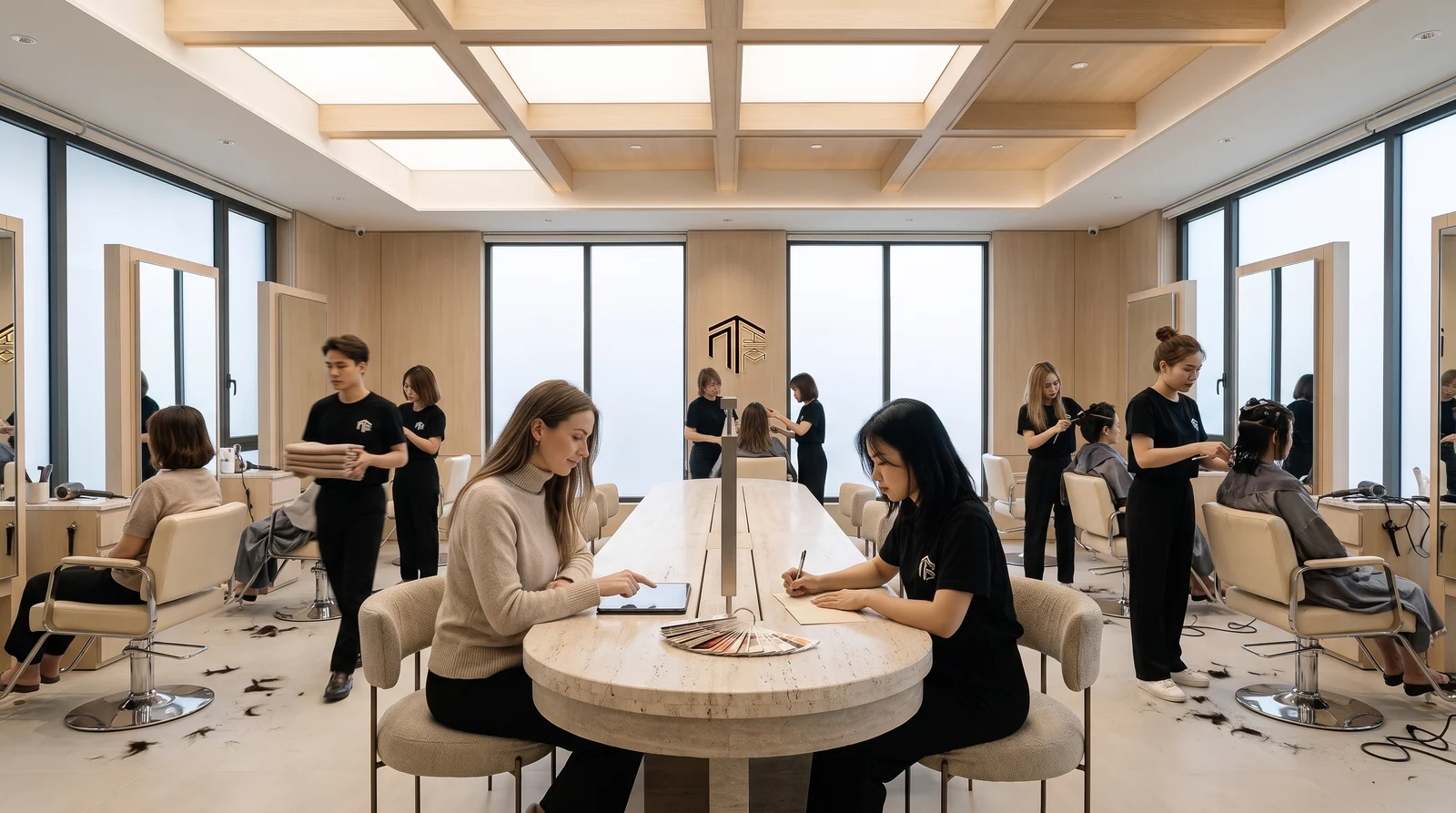
What to send before you arrive
Two photographs, one you want and one you do not
The second photograph prevents more misunderstandings than the first one creates, because a shape you dislike rules out a whole direction in one second. Sending both ahead is covered in our guide to booking a Vietnamese salon by message.
Your hair history in three lines
Write what was last done, roughly when, and whether a home kit was ever involved. For example: dyed dark brown in May, box colour, nothing since. Those three lines change what is realistic far more than any photograph does.
The sentence about your time
Tôi cần xong trước 4 giờ ạ means I need to be finished before four o clock. Say it when you book and again when you sit down. A salon told early can simply offer you a different plan.
What you will hear back, and what it means
At the basin
Mời chị vào gội đầu ạ invites you to the wash station. Chị ngả đầu ra sau ạ means lean your head back. Nước nóng được không ạ? asks whether the water is comfortable, and được ạ means it is fine.
About price and waiting
Bao nhiêu tiền ạ? is how much, and Cho tôi xem bảng giá ạ asks to see the price list. Chị đợi mười phút nữa ạ means ten more minutes of processing. At Nhat Tam a designed women’s cut with wash, cut and dry is listed at 250,000 VND, or 150,000 VND with the booking and check in offers, published on our salon price list.
When a stylist says it cannot be done today
Hôm nay chưa làm được ạ means not today. On hair with old colour, recent bleach or visible breakage it is the most valuable sentence you will hear all afternoon, and it usually arrives with an alternative. Treat it as expertise rather than refusal.
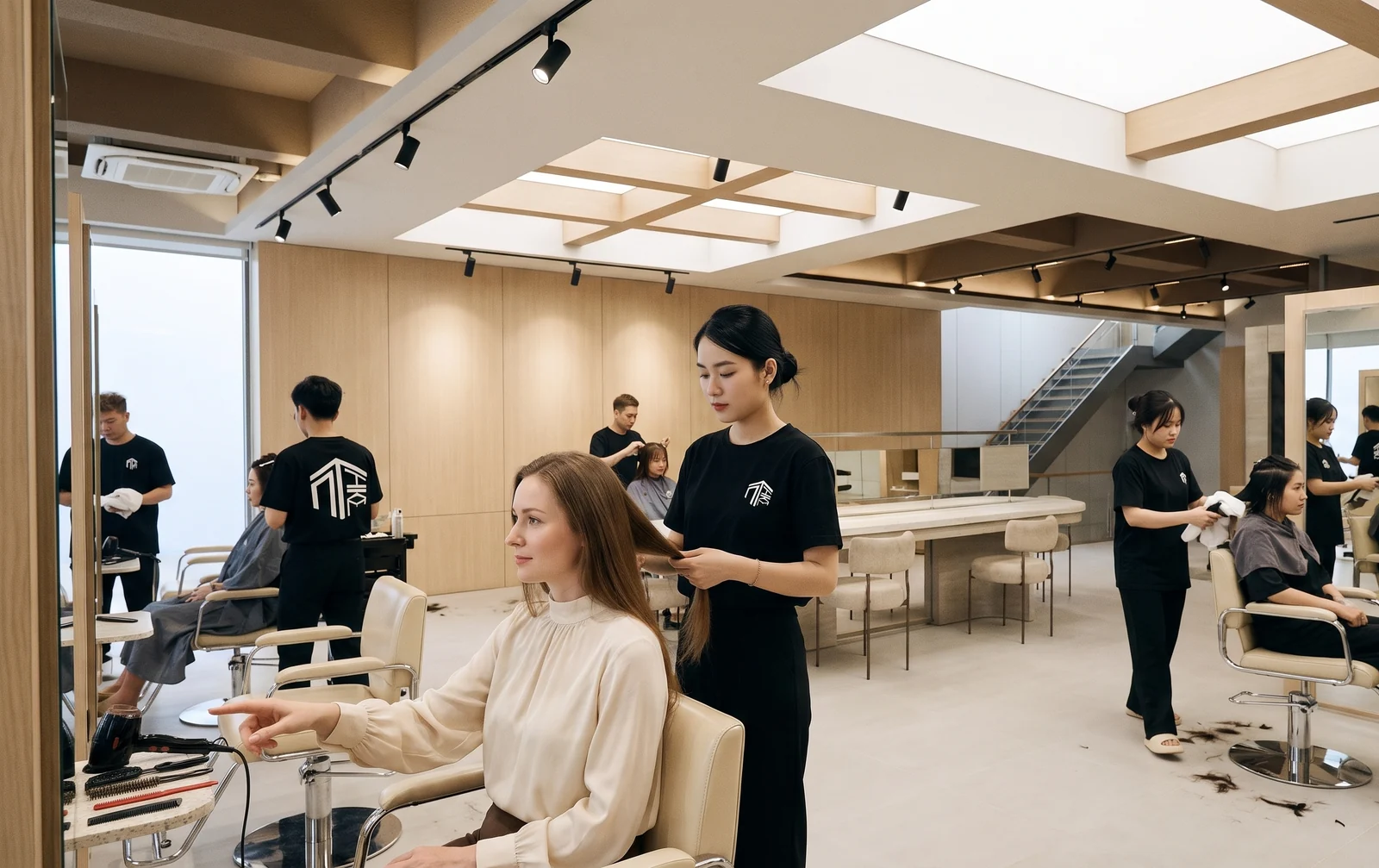
When the tones defeat you, and they will
Say the number and point
If a phrase does not come out right, say the number and touch the place where the length should stop. Numbers are the easiest Vietnamese to pronounce, and a finger on a strand is unambiguous in any language.
The two phrases worth practising anyway
Dừng lại ạ and Chờ một chút ạ. Everything else can be shown on a screen, but these two sometimes need saying quickly, and both take a minute to learn.
What this guide cannot do
Ten phrases will not let you negotiate a colour correction, describe an allergy, or discuss what three years of bleaching did to your ends. They are built for instructions that are short, concrete and time critical. Anything involving hair history, chemical limits or a result spread across several visits needs a real conversation, and for those appointments book English support rather than rely on this page. Nothing here is medical advice, and a scalp or skin problem belongs with a doctor.
Frequently asked questions
Do I need any Vietnamese at all to get a haircut in Hanoi?
No. Plenty of visitors are looked after with photographs and gestures alone. The phrases shift the odds, especially for fringes, thinning and anything with a number attached.
Is it rude to show a phrase on my phone instead of speaking?
Not at all. It reads as being prepared, and Vietnamese clients do the same thing with reference photographs every day.
Which single phrase should I learn if I only learn one?
Dừng lại ạ. Stop is the one instruction that has to work immediately, and it is two words long.
Are these phrases the same in Ho Chi Minh City?
The words are standard across Vietnam. The accent differs, so a northern and a southern stylist will say them differently, but what you show on screen reads the same everywhere.
What about tipping, is there a phrase for that?
Tipping is not expected and no phrase is needed. How it actually works is covered in our guide to tipping at Vietnamese hair salons.
Where can I see the rest of your English pages?
They are collected on our English services page, and the checks worth running on any salon are listed in our guide to choosing a hair salon in Hanoi as a foreigner.
Book an English supported consultation in Hanoi
If you would rather have the plan agreed before anything is cut or mixed, book a consultation at Nhat Tam Hair Salon, 89 Nguyen Hy Quang, O Cho Dua, Dong Da, Hanoi. Send your two photographs and your three lines of hair history when you book, and we will confirm in writing what is realistic in one visit. You can book an appointment online or message any of our four branches in Hanoi, Thai Nguyen, Ha Long and Hai Phong. First time in a Vietnamese salon? Our guide to salon culture for first timers walks through the whole visit.